
The artificial intelligence market had a turbulent Friday after a Beijing startup released a model capable of outperforming Anthropic's best programmer. Shares of AI and semiconductor companies plunged across Asia.
Moonshot AI unveiled Kimi K3 on Thursday, and investors quickly dubbed the episode the "Kimi moment." The reference is to the shock caused by DeepSeek, which wiped about US$ 600 billion from Nvidia's market value in a single session.
What the company built was a model with 2,8 trillion parameters and a context window of one million tokens, about four times larger than the previous version. It uses a mixture-of-experts design, activating only 16 out of 896 available for each task.
This approach is what makes it possible to maintain such a large model at low computational cost. According to Moonshot's technical blog, the architectural changes deliver scalability efficiency about 2,5 times greater than that of the previous generation.
In Arena's front-end coding ranking, K3 scored 1.679 points, versus 1.631 for Anthropic's Claude Fable 5 and 1.618 for OpenAI's GPT-5.6. It led six of the seven categories and took first place overall.
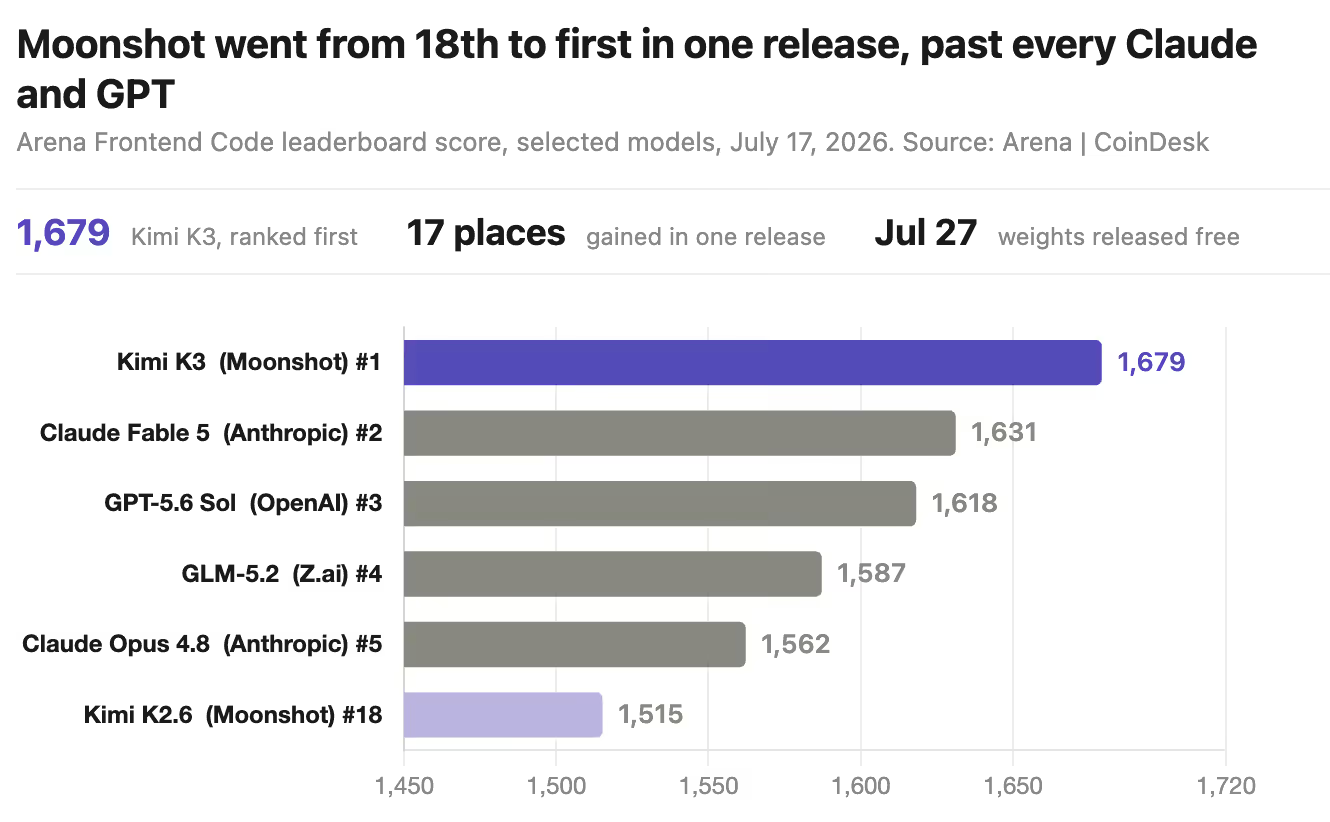
Moonshot's previous version ranked only 18th, a jump of 17 places in a single release. In broader tests of general knowledge, however, K3 still trails the best configurations from Anthropic and OpenAI.
It is, therefore, a victory concentrated in programming, not on all fronts. Even so, the detail that moved the market most was the license.
K3 is open-source, with public release scheduled for 27 de julho. Anyone will be able to download it, run it on their own hardware, and pay nothing for it.
The premise underpinning spending of hundreds of billions of dollars on AI infrastructure is that cutting-edge capability remains scarce, expensive, and American. A free Chinese model at the top of a programming ranking cuts directly against that argument.
Among the most affected were Moonshot's own domestic competitors, with Z.ai falling about 27% and MiniMax close to 16%.