
Searching for the best no-KYC crypto debit cards in 2026 can save you time and preserve your privacy, but the choice needs to be safe and compatible with your spending habits. Here you’ll find a practical review of the most relevant options for 2026—such as Bitsika Virtual Card, BingCard, SolCard, Laso Finance, and Goblin Card—and really understand how each one works, where they shine, and where they fall short.
If your goal is to spend crypto with more privacy and convenience, this guide shows which cards offer quick issuance, support for stablecoins or popular tokens, and different levels of anonymity. Also, be aware of the risks involved.
Next, you’ll see how these cards operate, criteria for choosing the best for your profile, and signs of when a no-KYC card does (or does not) make sense for you.
What are no-KYC crypto debit cards?
These cards allow you to spend cryptocurrencies directly on a physical or virtual card without needing to provide identification documents. They convert your digital coins to fiat currency at the time of purchase or top-up, keeping the registration process very simple.
Difference between no-KYC and traditional cards
With traditional cards, you need to go through KYC: submit an ID, proof of address, and sometimes even a selfie. With no-KYC cards, that step disappears—the issuance is fast and you can start using it almost immediately, both online and in person.
Both use encryption and anti-fraud monitoring, but without KYC the responsibility increases: if you lose the card or the keys, recovery may be impossible. Spending and top-up limits are usually lower to prevent abuse.
There’s also the regulation issue. Traditional cards follow strict rules from banks and issuers. No-KYC cards usually operate via Web3 services or issuers in more flexible locations, which can affect acceptance and support in large networks.
How do crypto cards work?
You apply for a crypto debit card with the provider, create an account and usually connect a crypto wallet. Some cards have an integrated wallet; others require you to transfer funds from your external wallet to the card balance.
At a physical store, you use the card like a normal debit card (chip, swipe, or contactless). The system converts the amount of crypto to fiat currency at the time, using the current exchange rate.
For online purchases, just enter the card details and the conversion happens at checkout. ATM withdrawals work similarly: your crypto gets converted to fiat at the moment of withdrawal and the ATM releases the cash.
Withdrawals may have different fees and limits compared to purchases. Crypto cards offer security features such as PIN, EMV chip, and two-factor authentication (2FA).
You can block or unfreeze the card via the app if you lose it; most providers monitor transactions and alert about suspicious activity.
About custody: some cards are custodial (the provider holds your assets) and others are non-custodial, where you keep control of the keys. This detail changes responsibility, privacy, and how to recover the account.
Top-ups and crypto card models
You load the card by sending crypto (BTC, USDT, USDC, ETH, etc.) to the platform or by connecting your wallet. The conversion to fiat happens automatically, either at top-up or at purchase, with real-time exchange rates.
There are two main models: prepaid card—you convert at top-up; direct card—conversion only happens at purchase. Fees appear as exchange spreads, fixed commissions, or a percentage per transaction.
Key control varies: some cards require custody (the issuer holds the funds); others are non-custodial and only authorize conversion when you request. Always check top-up limits, conversion speed, and which cryptos are accepted before deciding.
Best crypto debit cards without KYC 2026
Table: Best crypto debit cards without KYC 2026, summary.
CardMain featuresPoints of attention
Bitsika Virtual Card
Virtual Visa card with no initial KYC, reloadable with BTC and USDT, integration with Apple Pay, Google Pay, and PayPal, usable in more than two hundred countries, encryption and two-factor authentication.
Virtual only, limits and anti-fraud locks for higher values, variable conversion fees, and possible regional blocks.
BingCard
Virtual card with fast issuance and no KYC, supports BTC, ETH, USDT, and USDC, instant conversion, competitive fees, and physical card option with verification.
Mixed reliability reports, possible unexpected charges, occasional blocks, and dependence on support for resolution.
SolCard
Prepaid card focused on Solana, uses SOL, USDT, and USDC, instant issuance, compatible with Apple Pay and Google Pay, good for those already using the Solana network.
Limited support outside the Solana ecosystem, instability in some regions, and lower institutional presence.
Laso Finance
Prepaid card without KYC based on stablecoins like USDC, USDT, and DAI, instant issuance, integration with Apple Pay, Google Pay, and Samsung Pay, less exposure to volatility.
Difficult account recovery without KYC, policies and limits subject to regulatory changes, and varying reports of blocks.
Goblin Card
Physical or virtual card with no KYC, supports various cryptos including BTC, ETH, SOL, XMR, and USDT, higher daily limits, single fee with no monthly charge.
High initial cost, few consistent public reviews, need to pay attention to jurisdiction and AML rules.
1. Bitsika Virtual Card
The Bitsika Virtual Card is a digital Visa debit card that you generate through the app and use directly from your mobile wallet. It displays number, expiration and CVV, but it's virtual only — perfect for online purchases or integration with Apple Pay, Google Pay and PayPal, and it's one of the best no-KYC crypto debit cards for 2026.
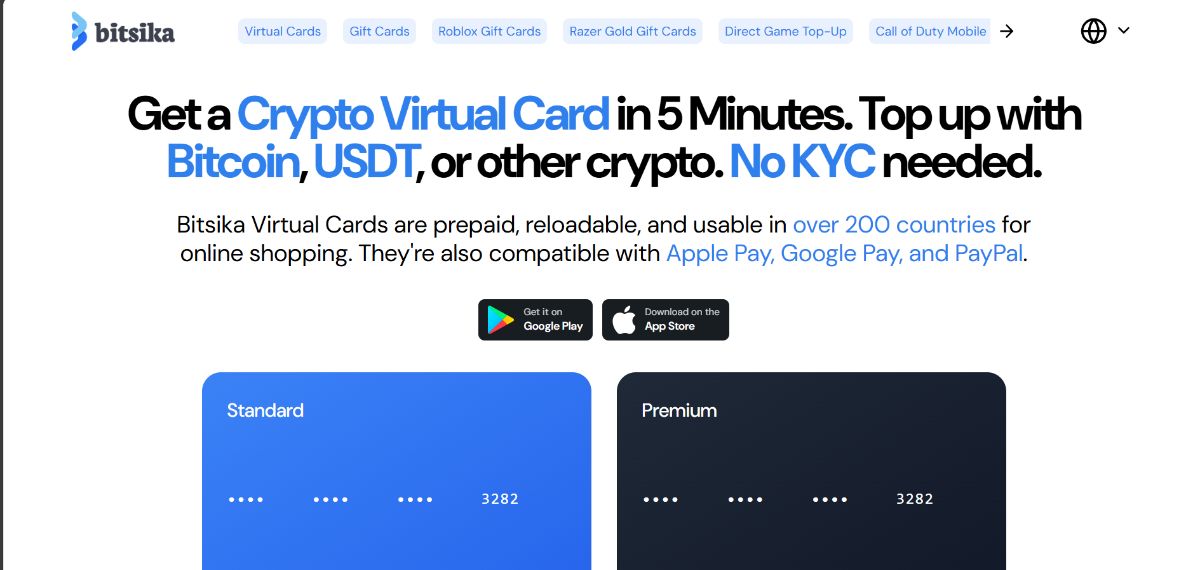
You can load the card with Bitcoin, USDT and other cryptocurrencies. The balance updates almost instantly. No KYC is required to start, so access is fast, but there may be limits and anti-fraud controls that block larger transactions.
The platform offers industry-standard encryption and two-factor authentication (2FA) to protect your account. The lack of KYC reduces the information shared, which improves privacy, but changes the protection profile against money laundering.
Use Bitsika for subscriptions, international purchases, and payments in more than 200 countries where Visa is accepted. Always test with small amounts, check conversion fees, and look into regional blocking policies before using it directly.
Bitsika Virtual Card has a 4.1-star rating on the Play Store at the time of this writing and can be used in over 200 countries. Quick points:
- Type: Reloadable virtual Visa debit card.
- Funds: BTC, USDT and other supported cryptocurrencies.
- Integration: Apple Pay, Google Pay, PayPal.
- Security: encryption, 2FA available; KYC optional/at first.
Download Bitsika Virtual Card:
2. BingCard
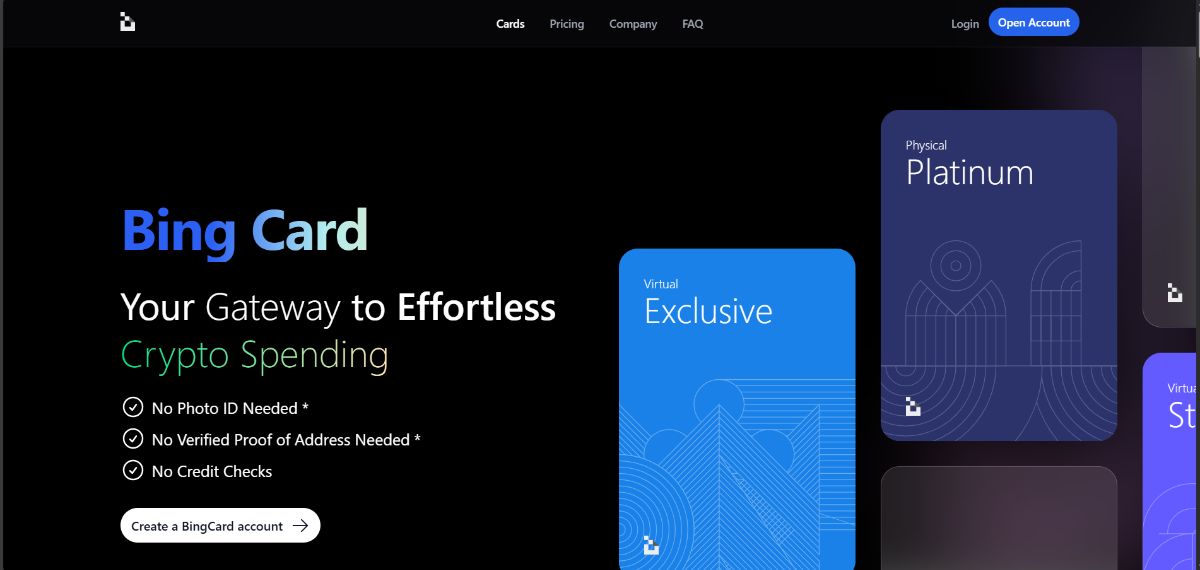
BingCard offers no-KYC virtual cards that you can issue in minutes, plus an optional physical card with verification. You can load it with BTC, ETH, USDT, and USDC, and pay instantly with real-time conversion, earning its place among the best no-KYC crypto debit cards for 2026.
Convenience is the highlight: quick issuance, support for various tokens, and integration with digital payments make it easy to use day-to-day. Low fees and instant top-ups help those who want to spend crypto like regular money.
Reports on reliability and customer service are mixed. Some praise the acceptance and deposit options, but there are also complaints about unexpected charges, issuing failures, and blocks only resolved by support.
Before using, compare daily/monthly limits, issuance fees, and fraud dispute policies. Check reviews on independent sites and start with small amounts to test.
Security includes real-time transaction monitoring. But services without KYC generally have more limited legal and operational guarantees. It is worth considering features such as 2FA, encrypted communications, and instant card freezing in case of suspicion.
BingCard has a rating of 2.7 out of 5 possible points on the Trustpilot website. Overall, users were satisfied with the card, but some people report issues with funds disappearing after deposits on the platform.
- Click on "create a BingCard account" on the Bing Card home page to get started. No document or verified address is required.
3. SolCard
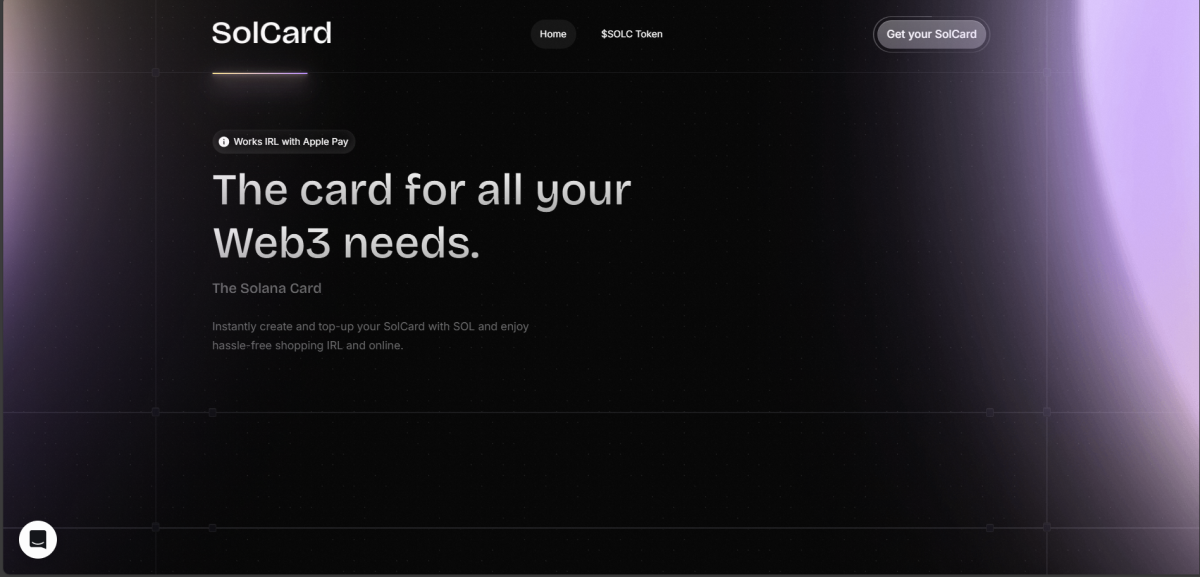
SolCard is a prepaid card that uses SOL (Solana) as its main balance and allows you to spend crypto without KYC. You receive a virtual card instantly and can add it to Apple Pay or Google Pay for online payments and in stores that accept Visa.
Integration with the Solana network reduces latency and makes it easy to top up in SOL, USDT or USDC directly on the blockchain. This is practical if you already have assets on Solana and want to convert crypto into everyday purchases.
The product is more community-oriented than aimed at large institutions. Discussions, guides, and reviews appear frequently in forums such as Reddit and Discord.
Reports vary: some confirm it works without problems, others mention instability in certain regions. Basic security includes two-factor authentication (2FA) and encryption to protect data and transactions.
Check anti-money laundering (AML) policies and the limits for your country, as the absence of KYC may bring restrictions depending on the jurisdiction.
- Advantages: quick issuance, compatible with mobile wallets, good for those who already use Solana.
- Limitations: restricted support for cryptos outside Solana, reputation varies and possible lack of global institutional support.
Users on Reddit describe their experiences with SolCard as generally positive, highlighting the ease of using it for online purchases, noting that it is possible to pay for different products, from groceries to electronics.
- Visit the SolCard official page and click on "Get Your SolCard" to get started.
4. Laso Finance
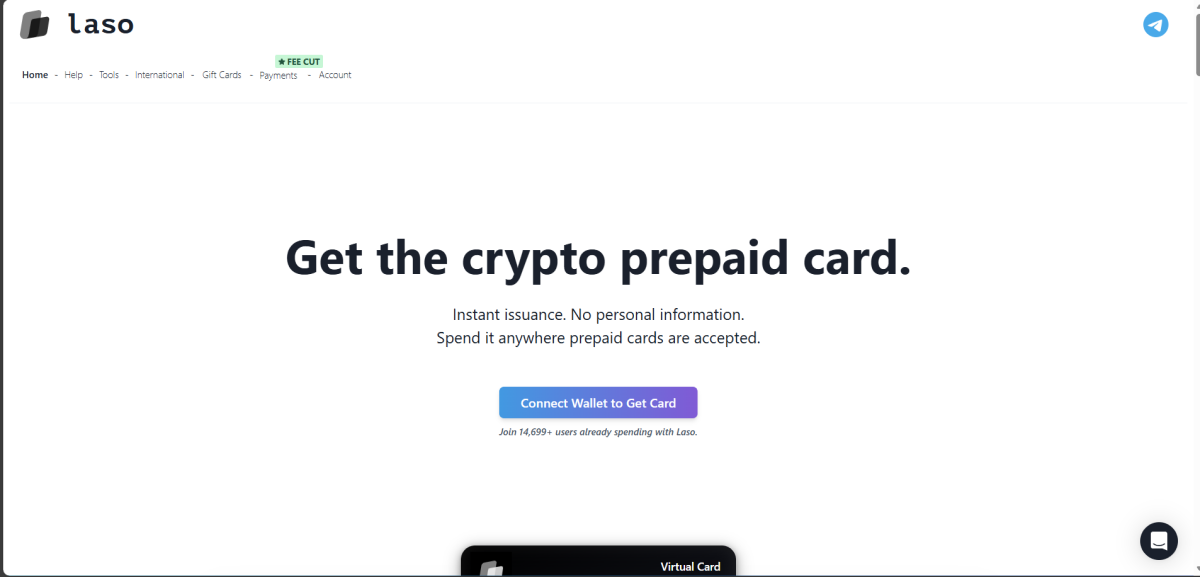
Laso Finance ranks 4th among the best no-KYC crypto debit cards, offering reloadable prepaid cards using stablecoins like USDC, USDT, and DAI, so you spend crypto without having to convert volatile assets into fiat on your own. Issuance is instant and does not require personal data, which makes registration easier.
The cards work with Apple Pay, Google Pay, and Samsung Pay, making mobile payments easy anywhere that accepts prepaid cards. This is useful for everyday purchases, subscriptions, and international spending, with less exposure to volatility.
The advantages are price stability (due to stablecoins) and speed in obtaining the card. But without KYC, account recovery can be difficult, and policies or limits may change as regulations tighten.
On the technical side, security includes encryption and anti-fraud controls. Solutions without KYC rely more on behavior monitoring and on-chain analysis than on formal identification.
Features like instant freeze and 2FA increase protection, but check if these mechanisms are active before trusting your funds. Compare exchange rates, withdrawal fees, and operational limits. Read the terms of service and look for independent reviews — user reports range quite a bit from efficient support to unexpected transaction refusals.
Laso Finance has a score of 3.2 points on the Trustpilot website, given by a single user. On Reddit one user commented that uses the card, it works well with digital wallets, and another user commented that they recently had issues with card refusals and loading the balance.
- Visit the official Laso Finance page and click on "Connect Wallet to Get Card" to get started.
5. Goblin Card
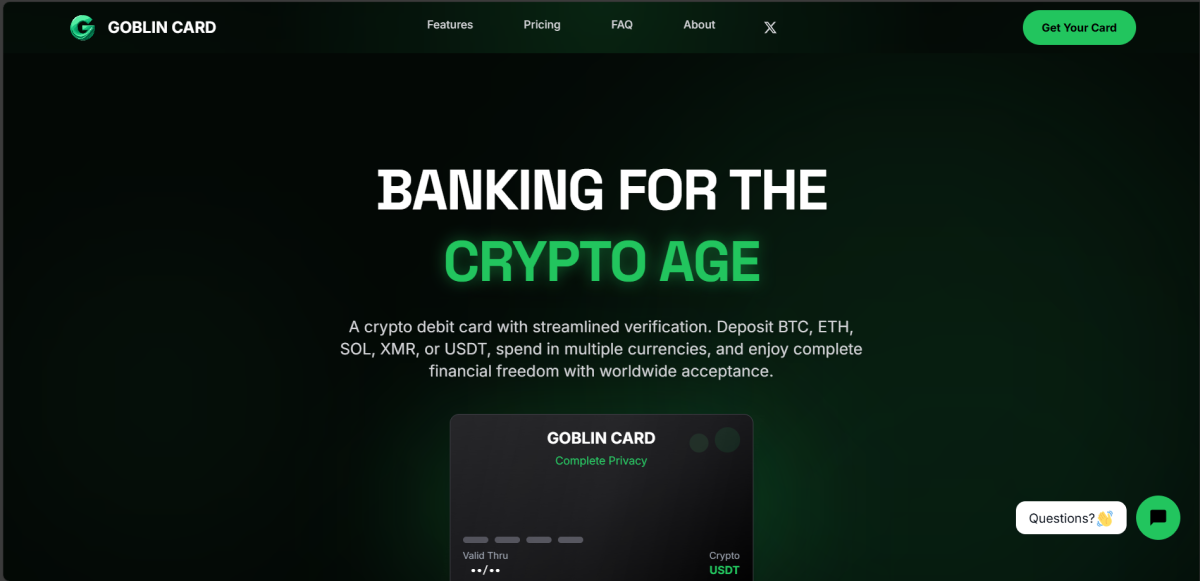
Goblin Card is a physical or virtual card that promises operation without KYC. It is aimed at those who prioritize anonymity and simplicity in daily spending.
It's possible to deposit several cryptocurrencies — BTC, ETH, SOL, XMR, USDT — and spend in different currencies. Daily limits are usually relatively high, which may please those who need more flexibility.
The product charges a one-time acquisition fee, so it has a higher upfront cost. On the other hand, you don't pay a monthly fee. This attracts those who prefer to pay everything up front to avoid recurring charges. It's not for everyone, but it may be worth it if you hate surprises on your statement.
In practice, it offers crypto-fiat conversion, ATM withdrawals and international shipping of the physical card. Daily usage tries to be as close as possible to a traditional card. But stay alert. Always check the issuer's jurisdiction, read the terms of service, and understand the AML policies.
This information helps to understand the legal obligations and the limits of anonymity. The lack of consistent public reviews is a warning sign; seek independent validation before buying.
Security also depends on you. Enable two-factor authentication (2FA), take good care of your private keys, and choose tools that allow you to freeze the card quickly in case of loss.
These measures reduce risks without losing convenience. It's worth repeating: security is never too much, especially with crypto.
We did not find any user reviews for this crypto card.
- Access the official Goblin Card page and click on "Get Your Card" to get started.
What are the risks of debit cards without KYC?
Cards without KYC navigate somewhat murky regulatory zones. Issuance may depend on intermediaries or local interpretation of laws, and these policies can change unexpectedly — sometimes requiring identity verification or terminating the service without notice.
The security of funds, even among the best no-KYC crypto debit cards, generally does not reach the level of traditional banks. If something goes wrong, account recovery processes are limited and customer support is usually basic.
This makes it difficult to prove the balance is yours or to recover money after fraud, blocking, or conversion error. It’s not uncommon to end up with no answers in these situations.
Fraud and technical attacks are real risks. Always enable 2FA when possible and prefer services with strong encryption to protect your data and transactions.
Custody also deserves attention. Many issuers keep funds in hot wallets; if you need extra protection, opt for cold storage for amounts you are not going to use right away.
Services with an instant card freeze option help avoid unauthorized spending. Better safe than sorry, right?
Be prepared for fees and limits that change without much notice. Spreads, hidden charges, or sudden changes can disrupt your financial planning.
In addition, dependence on third-party processors and networks increases the risk of service interruptions. Don’t count on total stability.
Treat these cards as convenience tools. They’re not safes: keep only what’s necessary for daily expenses and follow basic security practices.
How to choose the best no-KYC debit card?
Prioritize operational transparency, technical security, and clarity on costs. Practical tests and written proof help filter out empty promises and choose the right card among the best no-KYC crypto debit cards.
1. Check the issuer’s reputation and track record
Search for reviews on independent sources like Trustpilot, Reddit, and community channels (Discord, Telegram). Watch for patterns of complaints: blocks, uncredited deposits, unexpected charges.
See if support actually solves problems. Analyze public documentation: terms, FAQ, whitepaper, and app store pages.
Confirm information about card issuance, limits, and custody. If the company doesn’t explain how it protects funds or has no public history, it’s better not to risk high amounts.
Ask for technical evidence when possible. Links to policies, official screenshots, and written responses reduce the risk of unpleasant surprises.
Companies with a transparent record and fast incident resolution inspire more confidence. It doesn’t hurt to be picky in this part.
2. Analyze limits, fees, and conversion policies
Check all fees: crypto-fiat conversion, FX spread, withdrawal and inactivity fees. Add everything up to know the real cost of each transaction.
Hidden fees can wipe out any anonymous advantage. Also check which cryptos the card accepts and the rules for topping up.
Some only accept stablecoins or hold deposits for a while before releasing them. Check daily, monthly limits and possible restrictions for withdrawals or international payments.
Test with small amounts to see how the fees work in practice. Keep receipts and screenshots of the fees charged.
This makes contesting easier and allows you to compare what's written with what really happens. Testing beforehand always avoids headaches.
3. Prioritize security and access recovery
Demand the basics: two-factor authentication, data encryption, and good key storage practices. Find out if the platform uses cold storage for part of the funds and how it handles private keys.
Check how account recovery works. Without KYC, it can be more complicated; understand the support flows and what you need to prove in case of a problem.
Test the support before putting real money in. Open tickets, ask about response times, and see if they reply through official channels.
Services that allow freezing the card directly in the app and respond quickly to fraud reduce the risk of irreversible losses. Don't underestimate this point.
4. Consider jurisdiction and regulatory compliance
Find out the country where the company is registered and the local AML/KYC rules. Jurisdictions with clear laws are usually less unstable and offer less risk of sudden changes.
Evaluate if the company works well with payment networks (Visa/Mastercard) and if it publishes policies about legal requests. Providers in grey areas may be pressured to change their model, and this affects your access.
Also consider the legal consequences for you. Even without KYC, your country's legislation may require tax declarations or impose transaction limits.
5. Test operationally before migrating larger amounts
Make real operations with small amounts: card issuance, online purchase, mobile payment, and ATM withdrawal, if possible.
Write down fees, time the processes, and record everything with screenshots and receipts. Assess how support handles real situations: ticket opening, response time, issue resolution.
See if the card allows instant freezing in the app and if refunds work as promised. Only increase the amount after confirming everything matches the documentation.
If you notice inconsistencies or frequent delays, don't risk larger amounts. It's better to prioritize predictability than anonymity at any cost.
How to know if a card without KYC is for you?
First think about your level of crypto experience. If you already manage your own wallets, understand on-chain fees, and know how to convert between crypto and fiat, a card without KYC can be useful for occasional spending or travel.
Reflect on the role of the card in your daily life. They work well as a complement — to pay subscriptions, shop online or withdraw small amounts when traveling — but they do not replace a traditional bank account.
Consider the balance between privacy and protection. You expose less personal data, but take on the risk of blocks, policy changes, and lack of guarantees.
This requires discipline and acceptance of uncertainties. Not everyone feels comfortable with this scenario.
Also check the supported cryptocurrencies before requesting the card. If you use stablecoins like USDT, USDC, or DAI, or hold assets in Bitcoin, Ethereum, Solana, BSC, Polygon, Arbitrum, Optimism, or Base, confirm compatibility and accepted networks.
Test with small amounts and diversify. Don’t put everything into the service; prefer low top-ups and control your private keys.
Make a list of minimum criteria: accepted coins, conversion fees, limits, and blocking policies. If your priorities are flexibility and privacy—and you accept the responsibility—the card can work well for you.
Conclusion
Think honestly about your level of experience with cryptocurrencies before choosing one of the best no-KYC crypto debit cards. If you already understand self-custody, on-chain fees, and crypto–fiat conversion, these cards can be practical for occasional spending or travel.
Take into account the assets you use the most. Stablecoins like USDT, USDC, and DAI make payments more predictable. Bitcoin and Ethereum work well for liquidity, but networks like Solana, BSC, Polygon, Arbitrum, Optimism, and Base usually charge lower top-up fees.
There’s no denying it: privacy brings risks. No-KYC cards can be blocked, suddenly change policies, or even leave you stranded without support to recover funds.
Before transferring larger amounts, test with small transactions. Better safe than sorry. If autonomy and flexibility matter more to you than institutional guarantees, maybe a no-KYC card fits well into your crypto financial flow.
Now, if you prefer security and formal support, go with solutions that require verification. In the end, choose according to your risk profile, the cryptocurrencies you use, and the practical role the card will play in your daily life.